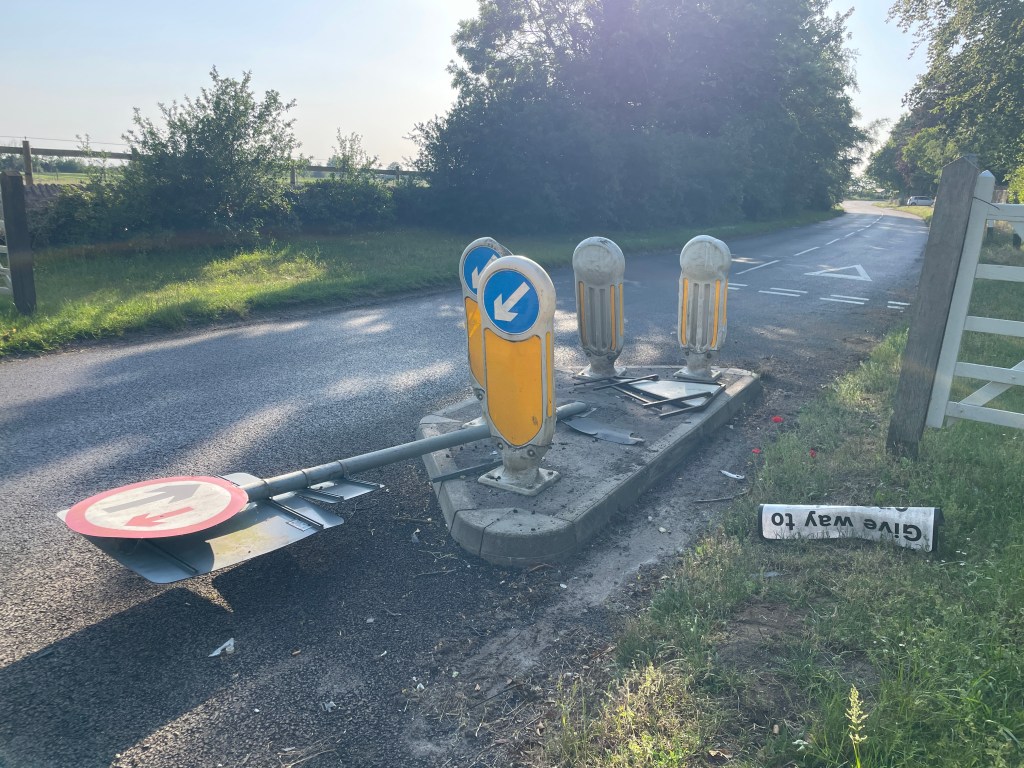
On 29 May, Oxfordshire County Council was eager to get out a press release with the headline “Oxfordshire bucking regional trend on road safety as casualty figures fall.” The claim was – broadly – people killed or seriously injured on the county’s roads fell by about 18% year-on-year, while across the wider Thames Valley they rose by about 20%. The clear implication – explained by the council’s new leader – is that this “strongly suggests the approach we have taken in Oxfordshire is working,” In other words, 20mph and Vision Zero schemes have worked.
It’s a great story. Lower speeds, safer streets, the county quietly doing the right thing while its neighbours flounder. I’d love to believe it, too. I cycle about 120 miles a week to and from work on the county’s roads as well as walking and driving.
There’s just one problem. The numbers don’t stack up and neither does OCC’s interpretation of them.
There’s truth in there, mind: Oxfordshire KSIs did fall about 18% and Thames Valley KSIs did rise about 20%. But the press release doesn’t tell you which numbers those are, what they’re being compared to, and what the Department for Transport’s data says about them in the small print.
TVP changed the way serious injuries are recorded
The DfT publishes road casualty figures in two flavours: “unadjusted” and “severity-adjusted.” That’s because 11 police forces – including TVP – have switched to a new way of recording injury accidents.
That change alters the number of injuries that get classed as ‘serious.’ That’s why DfT adjusts casualty figures. It means you can compare one year, or one place, with another. Their guidance could not be plainer: it’s the adjusted figures that “can reliably be used to compare trends over time across the country.”
The 18% fall OCC claims – and the 20% rise – both match the unadjusted series, the one you’re specifically not supposed to use for comparison. Run the same sums on the adjusted figures and Oxfordshire falls 17% (ok, it’s close) but Thames Valley rises only about 14%, not 20.% The contrast shrinks the moment you use the proper numbers. Funny, that.
OCC did the one thing DfT’s guidance explicitly warns against. When a force uses the new system for only part of a comparison, DfT says “there is a break in the series and comparisons are not reliable unless the adjustment is used.” OCC compared a 2024 measured the old way with a 2025 measured the new way, using unadjusted numbers, right across the join.
That’s not comparing two years; it’s apples and bicycles. And since Oxfordshire sits inside Thames Valley and changed the way they report on the same day as the rest of the Thames Valley, its celebrated 18% “fall” straddles the very same break. The honest verdict is that you can’t draw any reliable comparison for either across 2024 to 2025.
Admittedly, the press release is thoroughly sprayed with words like ‘provisional’ and ‘early signs’, but that doesn’t disguise the county’s politicians attempting to take credit or cover themselves in reflected glory – there’s even a big photo of the Council’s new Leader so you don’t mistakenly credit anyone else.
What about the fall in serious injuries?
Serious injuries (adjusted) were: 235 in 2019 and 243 in 2021 – both before the Twinkle Twenty and Vision Zero programmes. OCC starts imposing the new limits in February 2022, then the next three years go 305, 230, 261 – an average of 265; higher than the pre-programme level. Then 2025 sees the serious injury numbers dip to 215.
So after four years of 20mph schemes and ‘Vision Zero’, the county has landed barely 20 below where it sat in 2019, having spent years above that. OCC can’t take credit for clawing back to roughly where it started, especially when the years in between were worse.
If 20mph and Vision Zero work and get serious injuries down, why were 2022 and 2024 – both years where the new limits were being rolled out at pace – higher than pre-programme 2019?
Thames Valley is having a recording wobble.
Look at the DfT data table (you can download it here: https://www.gov.uk/government/statistics/reported-road-casualties-great-britain-provisional-results-2025), find the Thames Valley row on the 6th tab, and there’s a little marker against it: note 8. Note 8 says, in DfT’s words, that this police force has recently adopted injury-based reporting, that the severity adjustments are based on limited data, and that they “may be subject to greater revision in future years.”
Translated, because Thames Valley has changed how it records injury severity, a jump in “serious” injuries is exactly what you’d expect to see as the effect of that change regardless of what’s actually happening on the roads. The council has taken a number its own source flags as wobbly and presented it as hard evidence that everyone else in Thames Valley’s roads are getting more dangerous.
You can’t compare Oxfordshire to a thing that contains Oxfordshire
As much as OCC would like to declare independence, Oxfordshire isn’t a neighbour of Thames Valley, it makes up about a third of it. The press release is comparing a county to an area that includes itself, recorded by the same police force, on the same recently-changed system.
If you do the only comparison that actually makes sense – Oxfordshire versus the rest of Thames Valley – the rest of the patch goes from 344 to 510 KSI in a single year. That’s a 48 % jump. Nobody sane believes the roads of Berkshire and Buckinghamshire became 48% more dangerous in twelve months. It’s the recording change (see note 8, again) warping the figures.
And that depthcharges OCC’s argument; if the change to TVP’s recording of injuries can magic a 48% rise in one part of its area, the same change can just as easily produce an 18% fall in another part.
Small numbers don’t mean big changes – or trends.
Oxfordshire’s KSI figures over the last decade read like this: 361, 357, 281, 272, 232, 224, 241, 306, 232, 260, 213 – far from a smooth glide downwards. The scatter, year-to-year, is roughly a fifth of the average, which means an 18 % move in a single year is about one ordinary year’s worth of noise. The 213 we’re all meant to be celebrating – and attributing to 20mph limits and Vision Zero – sits comfortably in line with 2019, 2020 and 2023. The “fall” is mostly a bounce back down from a slightly high 2024.
And that’s our old friend ‘regression to the mean’ again, used to justify the apparent success of hundreds of speed cameras. A road sees 2 crashes in a year, a speed camera goes up and, magically, the following year there are no crashes. You could have put a garden gnome by the side of the road and seen the same effect.
Meanwhile, the year Thames Valley is being measured against, 2024, happened to be the lowest KSI total in the area’s entire eleven year run. Measure anything against its best-ever year and the next year inevitably looks like a deterioration.
DfT themselves, in the same release, warn twice that these numbers are volatile and that small groups produce “large fluctuations when comparing between years.” OCC must have read that release too as it’s the one they’re quoting.
The same number of deaths as 2021 – before 20mph and Vision Zero.
The release says serious and fatal collisions have fallen sharply. Sadly, this is another fudge. Oxfordshire’s road deaths in 2024 – 20. In 2025 – 18.
Two. Two fewer deaths. The same as in 2021, way before the council’s Twinkle Twenty and Vision Zero programmes.
Every one of those lives matters, and no-one would never wave away a real reduction. But two is not a trend, it’s entirely consistent with stats that have bounced between 18 and 34 all decade with no direction at all. And we’d already hit 18 deaths back in 2021 before a single 20mph scheme or Vision Zero under OCC’s programme existed.
Finally: the timeline doesn’t fit the story
Blanket 20mph limit funding was approved in February 2022, the same time as VIsion Zero. If the schemes were helping bring KSIs down, the programme years ahead should show it. Instead, Oxfordshire KSIs went up to 306 in 2022 (the first Twinkle Twenty/Vision Zero year), back down in 2023, up again to 260 in 2024, and down to 213 in 2025. A policy credited with a downward trend that includes two of the decade’s higher readings in its own rollout years is not a win.
Unfortunately for the Council’s narrative: the big, genuine fall in Oxfordshire casualties happened way before Vision Zero was imposed or Twinkle Twenties rolled out. All-severity casualties had already collapsed from 2,142 in 2015 to 1,043 in 2021 (the COVID floor) before the first 20 limit went in. By 2025 we’re at 1,028. Barely moved. Even OCC can’t reasonably claim credit for a decline that finished before they started.
What we have, stripped of the PR and councillor-aggrandising spin, is a bare correlation between one noisy number for a whole county and one county-wide policy, with no control group, no separation of the 275 20mph treated villages from the county total, no adjustment for the traffic volumes DfT explicitly warns about, and a confounding recording change sitting right there in the data. “Strongly suggests the approach is working” is doing Geoff Capes levels of heavy lifting.
So what is true?
Plenty. Oxfordshire’s roads are genuinely safer than they were a decade ago – thank goodness – but so is Great Britain as a whole, and we banked most of that improvement before Oxfordshire’s Twinkle Twenties and Vision Zero. Nationally, KSI actually rose 4% in 2025 and deaths fell 3%, so any county can find itself a few points either side of that purely by chance. We happened to land on the right side this year. That’s great, but it doesn’t justify a press release crediting a single policy with bucking a regional trend.
For the case for Vision Zero and 20mph to stack up, OCC needs to make it with the adjusted figures, with the recording caveat on the table, with a comparison that isn’t a county against itself, using the crash causation data from TVP’s Stats 19 forms and over more than one good year. Anything less isn’t road safety analysis. It’s marketing – and the data deserves better. So do the people who use the county’s roads.
Sources: Oxfordshire County Council press release, 29 May 2026; DfT, “Reported road casualties in Great Britain, provisional estimates: 2025,” 28 May 2026; DfT data table RAS91.





Leave a Reply